
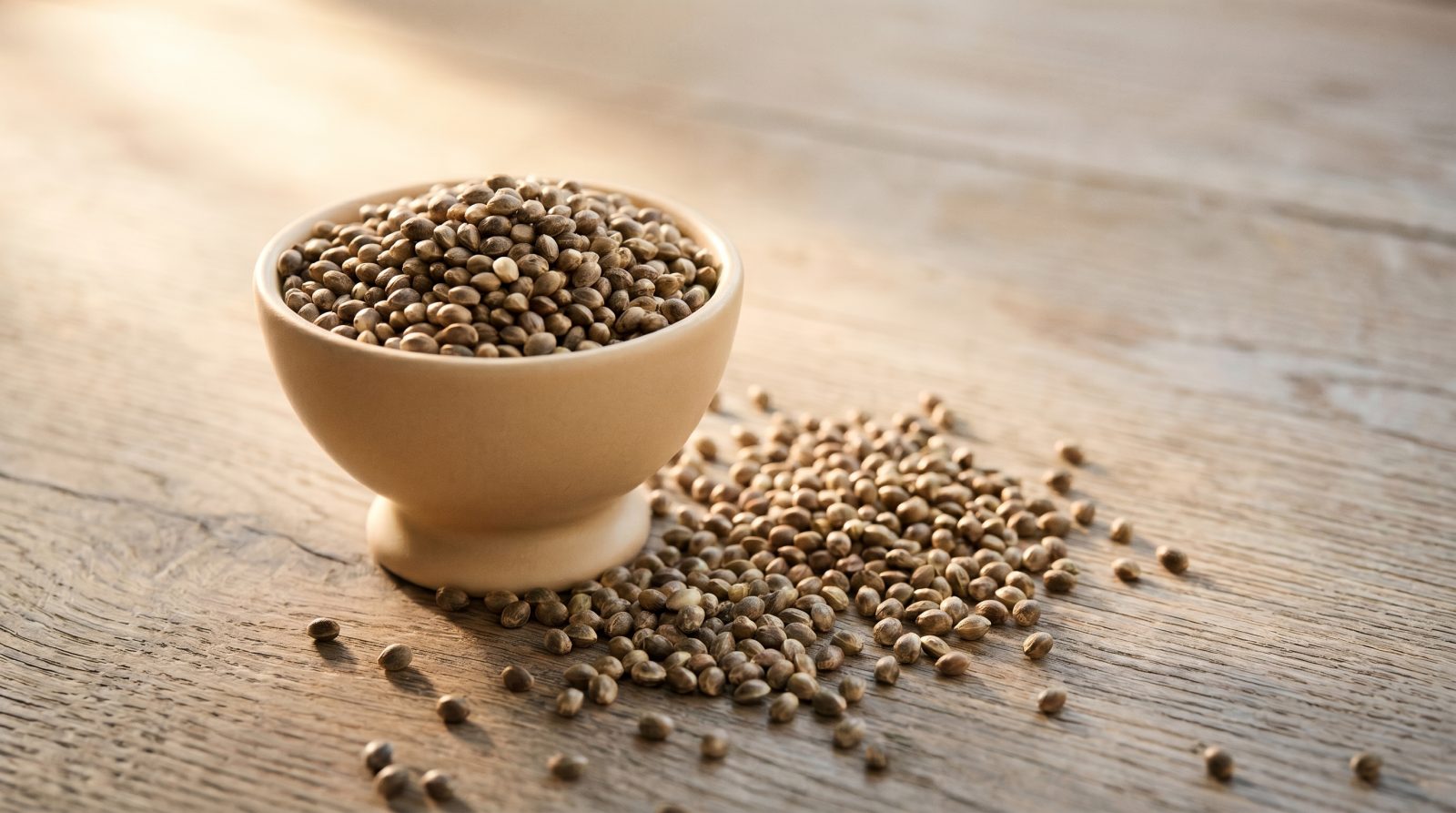
Whole hemp seed is one of the most nutritionally complete plant foods available, delivering complete protein, a balanced fat profile, and a dense supply of minerals in a single ingredient. This is the full breakdown of what a serving actually provides, what it does not, and how to read the numbers.
Full nutrition per 30 grams (about 3 tablespoons)
| Nutrient | Amount | % Daily Value |
|---|---|---|
| Calories | 166 kcal | 8% |
| Total fat | 14 g | 18% |
| Saturated fat | 1.4 g | 7% |
| Polyunsaturated fat | 11 g | n/a |
| Omega-3 (ALA) | 2.5 g | n/a |
| Omega-6 (LA) + GLA | 8 g + 0.4 g | n/a |
| Carbohydrate | 2.5 g | 1% |
| Fibre | 1.2 g (hulled) / 4 g (whole) | 4-14% |
| Protein | 10 g | 20% |
| Magnesium | 210 mg | 50% |
| Phosphorus | 495 mg | 40% |
| Iron | 2.4 mg | 13% |
| Zinc | 3 mg | 27% |
| Manganese | 2.2 mg | 96% |
The protein story
Hemp seed protein is what sets it apart from most plant foods. The 10 grams in a serving is a complete protein, containing all nine essential amino acids, which is uncommon outside of soy and quinoa among plants. The protein is built mainly from edestin and albumin, both highly digestible storage proteins. The limiting amino acid is lysine, easily covered by eating legumes elsewhere in the day. For the digestibility-minded, hemp's PDCAAS score sits around 0.46 to 0.66 for the whole seed, below animal proteins but solidly in complete-protein territory.
The fat story
About 80% of hemp's fat is polyunsaturated. The omega-6 to omega-3 ratio of roughly 3:1 is favourable compared with the typical Western diet, which often runs 15:1 or higher. Hemp also contains gamma-linolenic acid (GLA), an omega-6 derivative uncommon in everyday foods and associated with anti-inflammatory signalling. The honest caveat: hemp's omega-3 is the plant form, ALA, which the body converts to the long-chain EPA and DHA at a low rate. Hemp is a strong contributor to omega-3 intake, not a replacement for fish or algae oil.
The mineral standouts
- Magnesium: a single serving provides about half the daily target, which matters because a large share of adults fall short. Magnesium supports energy metabolism, muscle function and sleep.
- Manganese: nearly a full day's requirement per serving, supporting bone formation and antioxidant enzymes.
- Phosphorus, zinc and iron: all present in meaningful amounts. The iron is non-heme and absorbs better alongside vitamin C.
What hemp seed does not provide
Hemp seed is not a multivitamin. It contains little or no vitamin C, vitamin D, vitamin B12, or calcium. It should be treated as an excellent source of protein, healthy fat, and certain minerals, not as a complete nutritional solution on its own.
Whole seed versus hulled
The figures above are for hulled hemp seed (hemp hearts). Whole hemp seed, with the crunchy shell intact, carries substantially more fibre (around 4 grams per serving versus 1.2) and a little more of some minerals concentrated in the hull. The trade-off is texture: whole seed is crunchy and slightly bitter, while hulled seed is soft and mild. For fibre, choose whole; for everyday palatability, choose hulled.
How hemp compares to common seeds and nuts
| Food (30 g) | Protein | Magnesium | Complete protein? |
|---|---|---|---|
| Hemp seed | 10 g | 210 mg | Yes |
| Pumpkin seeds | 9 g | 170 mg | Nearly |
| Almonds | 6 g | 80 mg | No |
| Sunflower seeds | 6 g | 110 mg | No |
| Chia seeds | 5 g | 95 mg | No |
| Walnuts | 4.5 g | 45 mg | No |
By the combined measure of complete protein and mineral density, hemp seed leads this group, which is the core of its nutritional reputation.
Sources and further reading
- USDA FoodData Central for reference nutrient values of hemp seed.
- NIH Office of Dietary Supplements: Magnesium for recommended intakes and magnesium's role.
- Published nutrition panels from Canadian and US retail hemp brands, which vary within roughly 5% of these figures.