
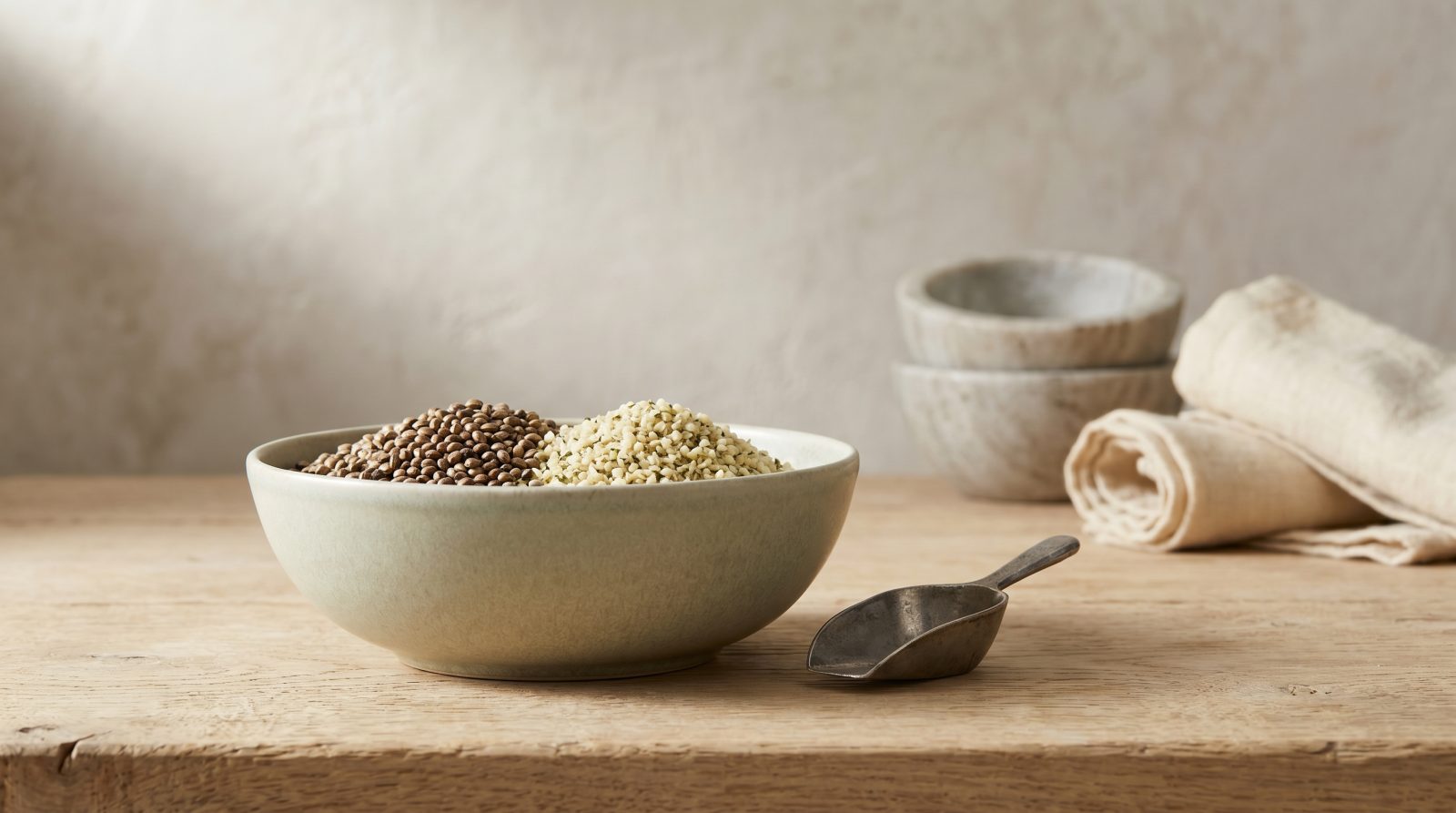
The hemp seed questions consumers most frequently ask, with current and concise answers grounded in the available evidence.
Are hemp seeds and hemp hearts the same thing?
Hemp hearts are hulled hemp seed (the soft kernel after the outer shell has been removed). Whole hemp seed includes the shell. The terms shelled hemp seed, hulled hemp seed, and hemp hearts all refer to the same product (the kernel without shell).
Can I eat hemp seeds raw?
Yes. Hulled hemp seed is normally eaten raw and requires no preparation. The mild flavour and soft texture make it suitable for direct consumption from the bag.
How many hemp seeds should I eat per day?
Two to three tablespoons (20 to 30 grams) of hulled hemp seed is a typical daily serving size suggested on most brand packaging. There is no Canadian dietary guideline specifically for hemp. Higher consumption is not associated with safety concerns; the constraint is fitting it into daily calorie and macronutrient targets.
Do hemp seeds need to be refrigerated?
Once opened, yes. Hulled hemp seed contains delicate polyunsaturated fats that oxidise faster at room temperature. Refrigerating after opening extends shelf life from approximately 4 to 6 weeks to 3 to 6 months. Freezing extends it further with no quality loss.
Are hemp seeds keto-friendly?
Yes. A 30 gram serving of hulled hemp seed contains approximately 1 gram of net carbohydrate. Hemp hearts are among the most keto-compatible plant foods.
Do hemp seeds contain THC?
Trace amounts only. Canadian and US food regulations require hemp seed to come from cultivars producing flowering material below the 0.3 percent THC threshold. The cleaned, dehulled seed contains far less THC than the flowering parts of the plant. Routine consumption of hemp foods produces no psychoactive effect.
Will hemp seeds make me fail a drug test?
Standard workplace drug testing is calibrated to detect THC metabolites from cannabis use, not from food consumption. Studies have shown that even high daily intake of hemp foods produces THC metabolite levels well below standard cutoffs. Individuals in safety-sensitive testing programs should check with their testing authority, as some specialised tests use lower thresholds.
Are hemp seeds safe for children?
Hemp seed is not on Canada's priority allergen list and is generally considered safe for children old enough to eat solid foods. Pediatric introduction follows the same general principles as introducing any new food: start with small amounts, monitor for allergic reactions, and consult a pediatrician for children with known seed or nut allergies.
Are hemp seeds safe in pregnancy?
Hemp seed as a food has no documented safety concerns in pregnancy. The product contains negligible cannabinoids and is treated as a standard food. CBD products and other cannabinoid extracts are a separate question; pregnant individuals should avoid CBD products specifically. Hemp seed as a food is not in that category.
Do hemp seeds expire?
Yes, gradually. The best-before date typically reflects 12 to 18 months from packaging. Stored properly (cool, dark, sealed), hemp seed can exceed the printed date by several months. The clearest spoilage indicator is taste: rancid hemp has sharp, bitter, or fishy notes.
Are hemp seeds anti-inflammatory?
The biochemical mechanisms are plausible (balanced omega ratio, GLA content), but direct clinical evidence of hemp seed reducing measured inflammatory markers in humans is limited. Hemp seed is part of an anti-inflammatory dietary pattern rather than a specific anti-inflammatory food.