
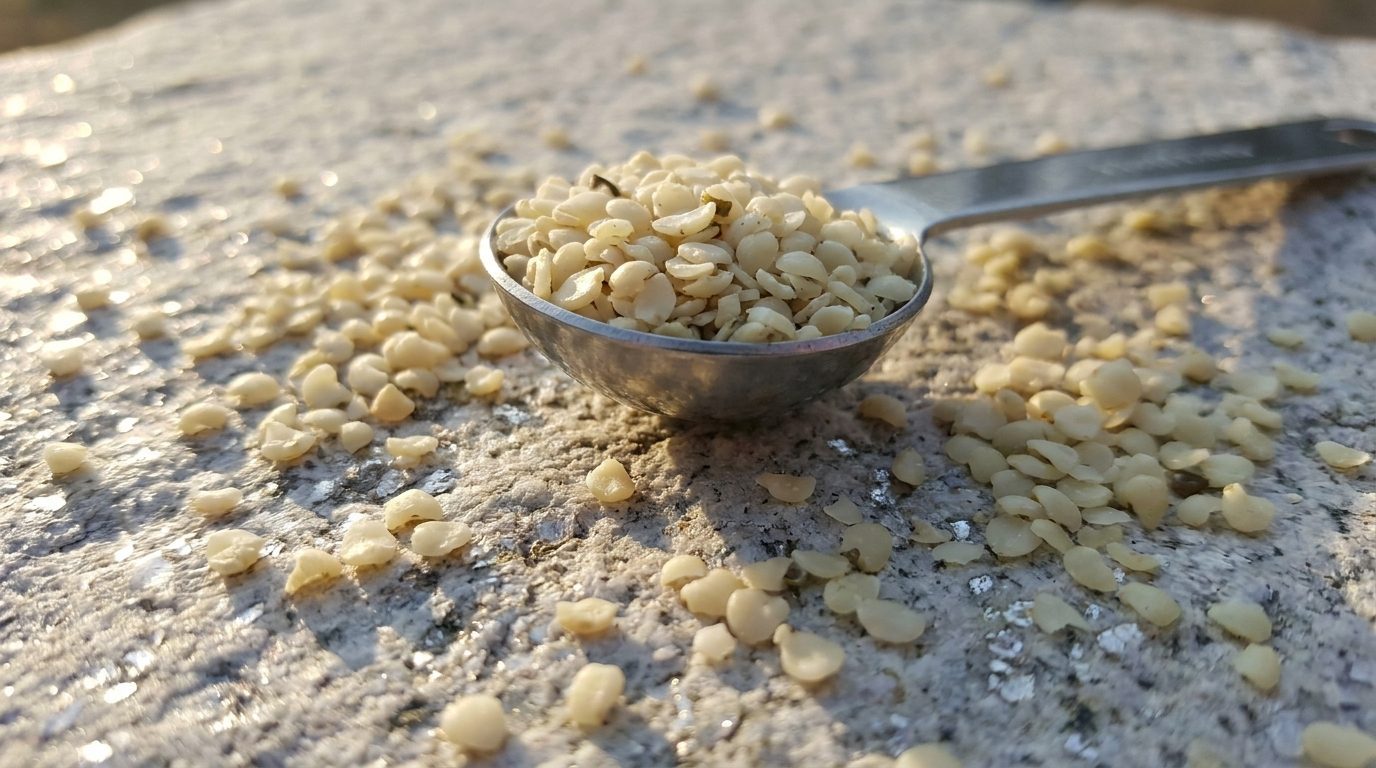
Hemp seed's mineral content is one of its least-discussed strengths — and magnesium is the one entry on the list that genuinely stands out rather than merely reads well.
Which minerals hemp seed carries in quantity
Like most oilseeds, hemp seed concentrates minerals in the kernel, which is exactly the part sold as hemp hearts. Hulling removes fibre but leaves the mineral fraction largely intact, so the pale green hearts are the mineral-dense product rather than a stripped-down one.
Four minerals appear in amounts worth talking about, and a fifth — potassium — shows up in respectable but unremarkable quantities.
| Mineral | Roughly per 30 g serving | What it contributes to |
|---|---|---|
| Magnesium | About 200 mg | Muscle and nerve function, energy metabolism, bone structure |
| Phosphorus | Several hundred mg | Bone mineral, cell membranes, energy transfer |
| Zinc | Around 3 mg | Immune function, wound healing, taste and smell |
| Iron | Around 2 to 3 mg | Oxygen transport, energy production |
| Manganese | Around 2.3 mg | Antioxidant enzymes, bone and connective tissue |
Figures shift with variety, growing conditions and soil, so treat these as the shape of the profile rather than a guarantee for any particular bag.
Magnesium: hemp seed's strongest mineral claim
Three tablespoons of hemp hearts supply somewhere near half an adult's daily magnesium requirement. Very few foods eaten in ordinary quantities do that. Pumpkin seeds and some nuts are in the same league; most everyday staples are nowhere close.
This matters because magnesium is one of the minerals where population-level intake genuinely tends to fall short, particularly on diets built around refined grains, which lose most of their magnesium during milling. Adding a mineral-dense seed to a refined-grain breakfast is a disproportionately effective intervention compared to adding it to an already whole-food-heavy diet.
The caveat is that magnesium status is not fixed by a single food. Alcohol intake, certain medications and heavy sweating all increase losses. Hemp seed moves the intake side of the ledger; it does not override the rest.
Zinc and iron: present, but how much gets absorbed?
Both minerals appear in useful amounts on paper. The complication is that the iron in hemp seed is non-haem iron — the plant form — which the body absorbs far less efficiently than the haem iron in meat. Zinc from seeds and grains faces a similar, though less severe, discount.
This is not a reason to dismiss the contribution. It is a reason to eat hemp seed in company. Vitamin C markedly improves non-haem iron absorption, so hemp seed scattered over fruit, tossed into a salad with citrus dressing, or stirred into a tomato-based dish is doing more for your iron than the same seeds eaten with tea. Strong tea and coffee alongside a meal work in the opposite direction, because the tannins bind iron.
For anyone managing low iron under medical supervision, hemp seed is a sensible dietary contributor and a poor substitute for whatever plan a clinician has set out.
What phytic acid does, and what actually reduces it
Seeds store phosphorus as phytic acid, and phytic acid binds minerals — particularly zinc, iron and to a lesser degree magnesium — reducing how much you absorb. Every seed, grain, nut and legume carries it. Hemp is neither unusually high nor unusually low.
The internet's standard advice — soak it — does not translate well here. Hulled hemp seed is already cracked open and oily; soaking makes it slimy without meaningfully reducing phytate, and it accelerates spoilage. Sprouting whole seed does reduce phytate, but that is a separate project with its own timeline.
The practical answers are more mundane. Eat a varied diet so no single food dominates your mineral intake. Pair hemp seed with vitamin C sources. And keep a sense of proportion: phytate matters most for people whose entire diet rests on unleavened grains and legumes, not for someone adding three tablespoons of seed to an otherwise mixed diet.
The minerals hemp seed will not cover for you
Hemp seed is not a calcium food. Compared with sesame seeds, almonds, dairy or fortified plant milks, its calcium contribution is minor, and no realistic serving size changes that. It also supplies no vitamin B12 — no plant food does — no iodine to speak of, and no vitamin D.
Selenium is worth flagging separately because its content in any plant food tracks the selenium in the soil where it grew, which varies enormously by region. Hemp seed is not a reliable selenium source anywhere.
Naming the gaps is what makes the strengths credible. A food that supplies half your magnesium and a real slice of your zinc and manganese is doing well; it does not need to be sold as covering everything.
Making the minerals count
Use hemp seed where it lands on something that helps rather than hinders absorption: over fruit and yogurt at breakfast, through a salad with a lemony dressing, or stirred into a bean or tomato dish after cooking. Keep the daily amount in the two-to-four-tablespoon range, which is enough to matter without crowding out other foods. Store the bag cold so the fat stays intact — the minerals are stable, but nobody keeps eating a seed that has gone bitter. If you want the full nutrient picture alongside the fat and protein numbers, our other hemp seed guides cover those in detail.